Milly Witkop and Rudolf Rocker, London, about 1900, photographer unknown. Archive Klaus Decker.
Following The Youth of a Rebel, Rudolf Rocker’s earliest memories, comes the second volume about his years in London, his acquaintance with Milly Witkop, and their joint activities surrounding the Yiddish anarchist newspaper Arbeter Fraynd. In their introduction, editors Klaus Decker and Tilman Leder focus on the chapters about Milly and give us insights into the little-known history of the Jewish labor movement in London’s East End.
Malka Lee. Date, place, and photographer unknown. Source.
Join us for an evening dedicated to Yiddish poet Malka Lee (1904—1976), one of the most distinctive voices of Yiddish modernism. Contemporary Yiddish poets Katerina Kuznetsova and Yael Merlini will introduce Malka Lee’s remarkable life story — from her beginnings in a Ukrainian shtetl to her creative years in New York — and trace the path of her literary awakening. Together, we will explore her debut poetry collection and read several texts in which she reflects with striking honesty on motherhood, the body, and self-expression.
Group photo of the Syndicalist Women´s League. Milly right in the background, with semi-covered face. Year and photographer unknown. Archive Klaus Decker.
In 1920s Berlin, Milly Witkop and Rudolf Rocker were at the center of many strands of the international and German anarcho-syndicalist movement. They were closely associated with Emma Goldman, Zenzl and Erich Mühsam. Milly was very involved in the Syndicalist Women’s League, whose inner-city Berlin group she led for a time. From 1926 onwards, she was secretary of the Berlin group of the International Workers’ Association’s relief committee for imprisoned anarchists and anarcho-syndicalists in Russia. In this lecture, we trace her commitment and let her speak for herself through her articles and appeals.
A lecture with reading by the FAU History and Future Working Group.
With this collective artistic research project initiated by Arndt Beck, YIDDISH.BERLIN is honoring an extraordinary figure: the feminist and anarchist activist Milly Witkop (1877–1955).
In the spring, Beck began tracing Milly’s footsteps in Yiddish archives and reading what they found with a small reading group. The result is a collective exhibition that investigates, honors, and makes visible Milly’s life through audio, drawings, text, mail art, collage, and more – accompanied by a series of events (see below).
Milly was born into a poor, frum family in the town of Zlatopil, in what is now Ukraine, the eldest of a tailor’s four daughters. At seventeen, she migrated on her own to London, where she soon became part of the circle around the Yiddish anarchist newspaper Arbeter Fraynd and one of the leading activists in the Jewish workers’ movement in early-twentieth-century London.
Milly lived through turbulant and combative times in England – including her own imprisonment and repeated migration. She then spent the Weimar years in Berlin, where she helped shape the Syndicalist Women’s Union (Syndikalistischer Frauenbund), and fled Germany immediately after the Reichstag fire, making her way to the United States via Switzerland. She lived outside New York for the rest of her life.
On the seventieth anniversary of her passing, we commemorate a life of political struggle for a just and humane world.
24 November – 2 December 2025, daily from 11 am
Opening: 23 November 2025, 4 pm
With an audio presentation by studio lärm and Anna Rozenfeld, a staged reading by Yossi Lampel, Guli Dolev-Hashiloni, Arndt Beck and music by Zhenja Oks.
And collective and individual artworks by Yael Merlini, Zuzanna Hertzberg, Ori Tor, among others.
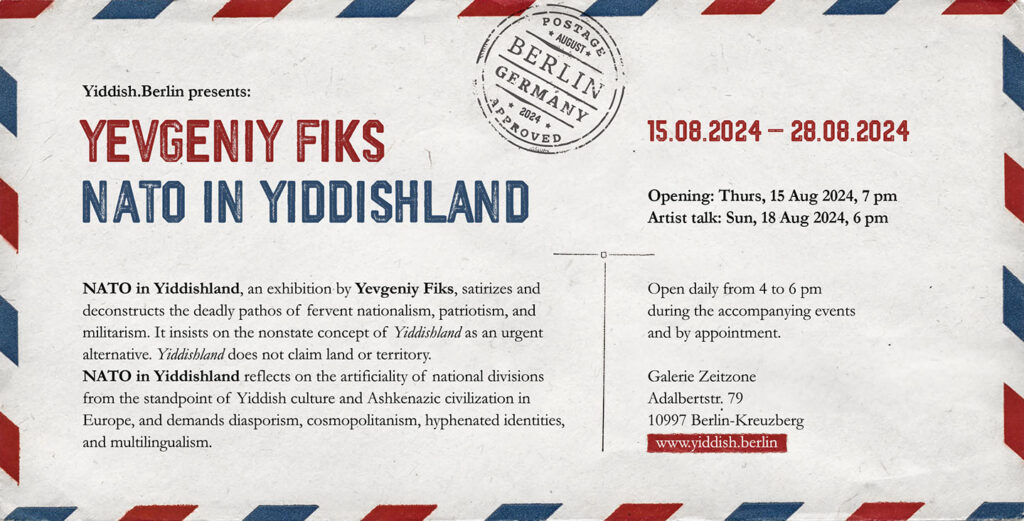
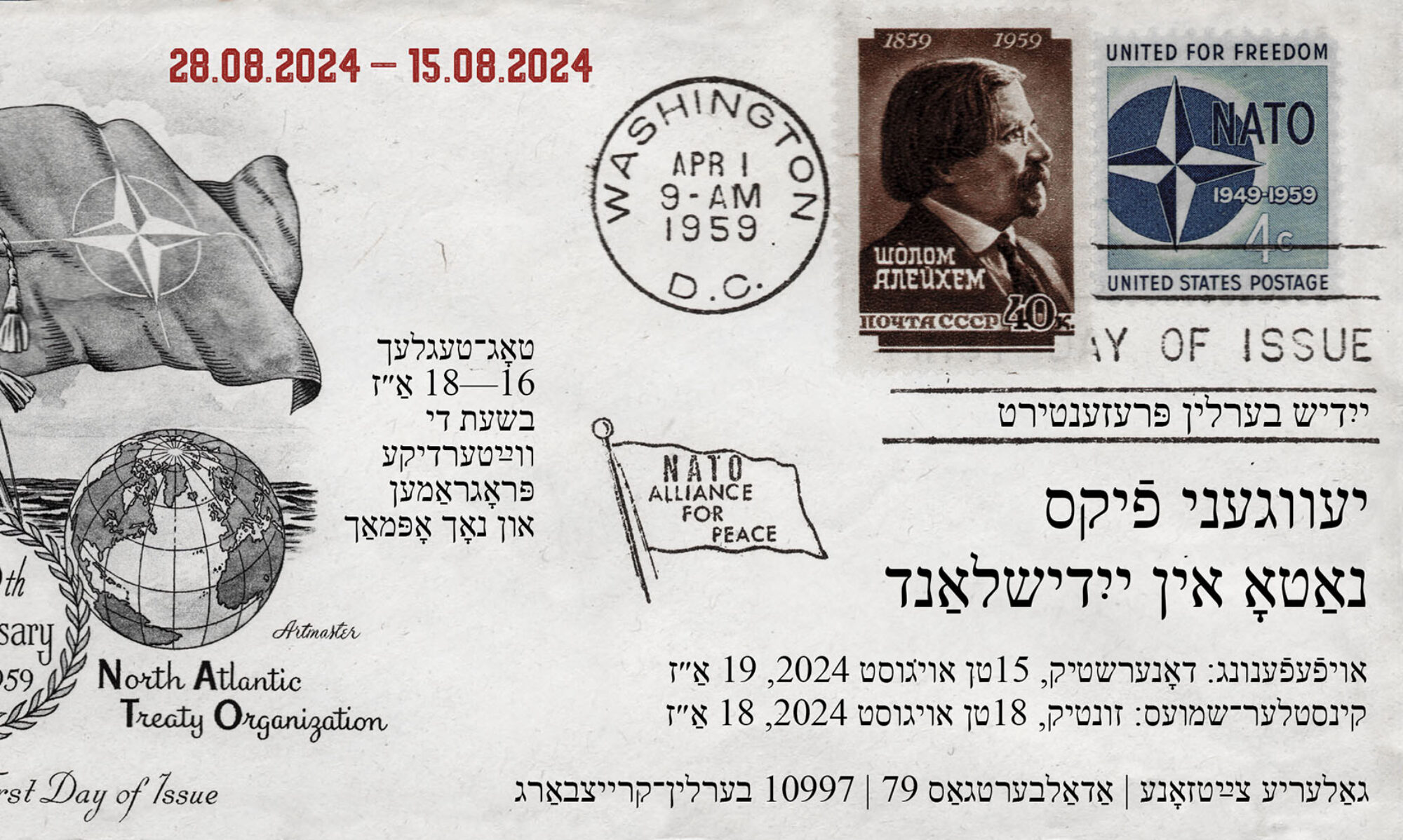
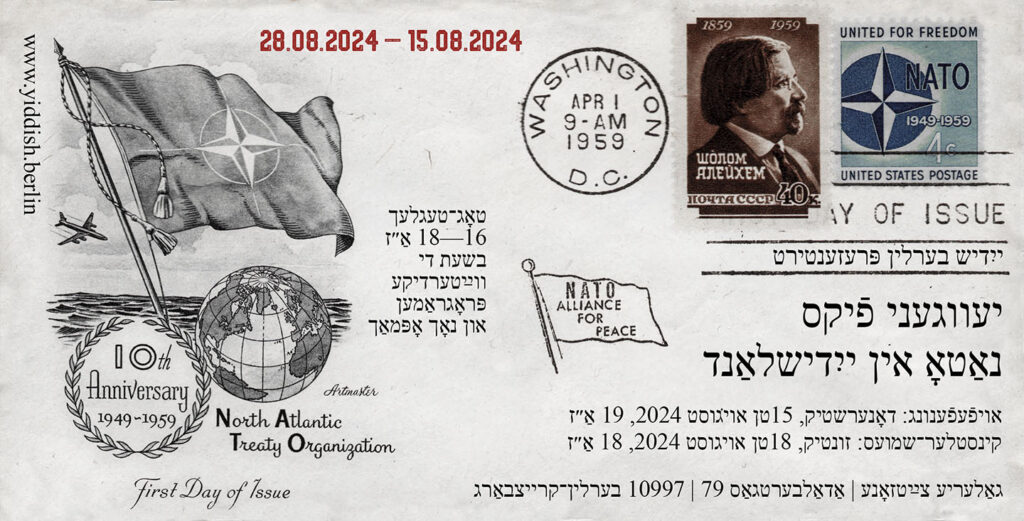
NATO in Yiddishland, an exhibition by Yevgeniy Fiks, satirizes and deconstructs the deadly pathos of fervent nationalism, patriotism, and militarism. It insists on the non-state concept of Yiddishland as an urgent alternative. Yiddishland does not claim land or territory. NATO in Yiddishland reflects on the artificiality of national divisions from the standpoint of Yiddish culture and Ashkenazic civilization in Europe, and demands diasporism, cosmopolitanism, hyphenated identities, and multilingualism.
***
This exhibition also marks Yiddish.Berlin’s 5-year anniversary. During this time, many people have invested their idealism, creativity, and priceless unpaid labor into cultivating the fertile ground on which a new Yiddish community has been growing in Berlin. Due to a last-minute loss of expected funding, we have now put forward the money for this exhibition out of pocket, which we unfortunately cannot afford ourselves. Your donation would help pay for our two weeks´ rent at the gallery, installation costs, live performances and presentations at the events, and making sure that there is someone in the gallery every day who can explain the concept of “Yiddishland” to anyone who walks in off the street. A sheynem dank!
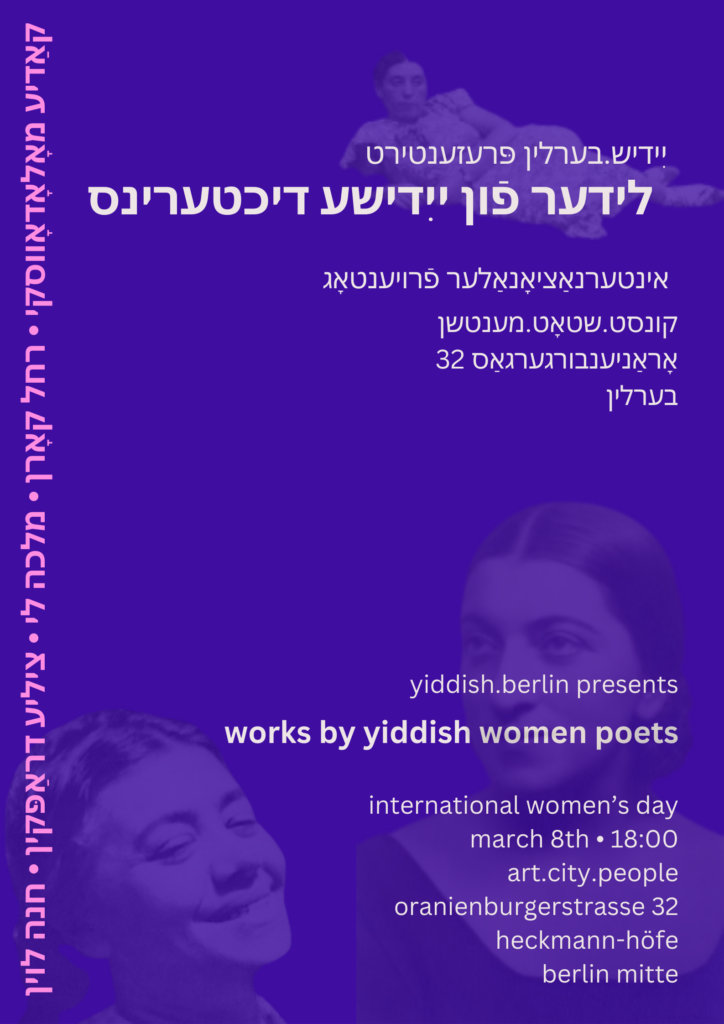
The International Women’s Day is an important holiday for us. This year we want to honour the works of women who have been creating Yiddish literature since the Middle Ages. We will recite works of famous Yiddish women poets, such as Kadya Molodowsky, Celia Dropkin, and Rokhl Korn, as well as less-known authors.
However, we don’t concentrate only on the past! That’s why in the second part you will hear contemporary works of Berlin Yiddishistkes: poetry, music, and translations.
Featuring:
Luise Fakler | Sandra Israel-Niang | Katerina Kuznetsova | Sasha Lurje | Yael Merlini | Rose Mintzer-Sweeney | Maria Stazherova | Ro van Wingerden | Iryna Zrobok
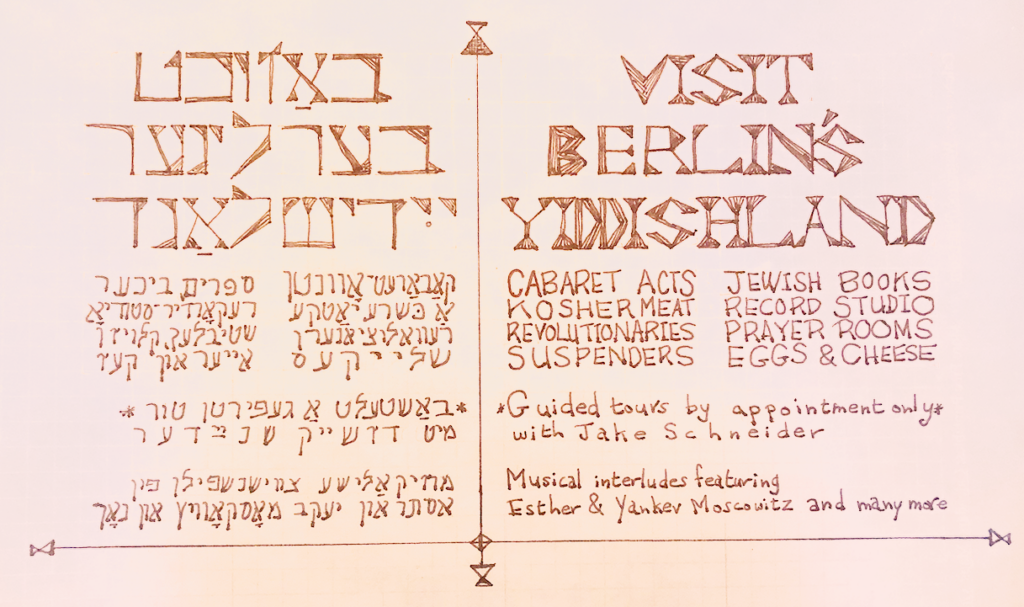
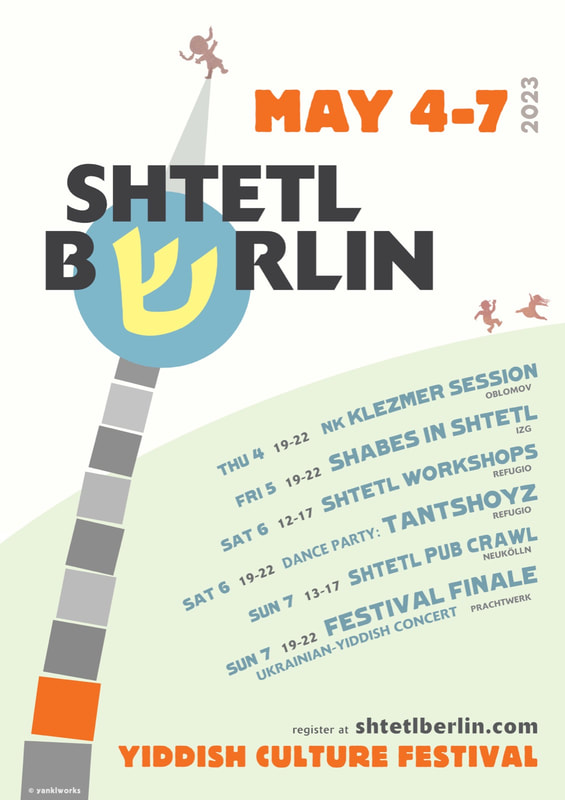
Is it Hanukkah already? No, this year our friends’ legendary SHTETL BERLIN festival is happening in the spring. Don’t miss the opening 95th Neukölln Klezmer session on Thursday. Make sure to catch Shabes in Shtetl Friday night (including some poems from Yiddish.Berlin). Dive into the workshops, dance at Tantshoyzbiz in vaysn tog arayn, then roll out of bed for the very first Shtetl Pub Crawl (where some of us will be speaking Yiddish). Which is only a warm-up for the grand Festival Finale. See you there!
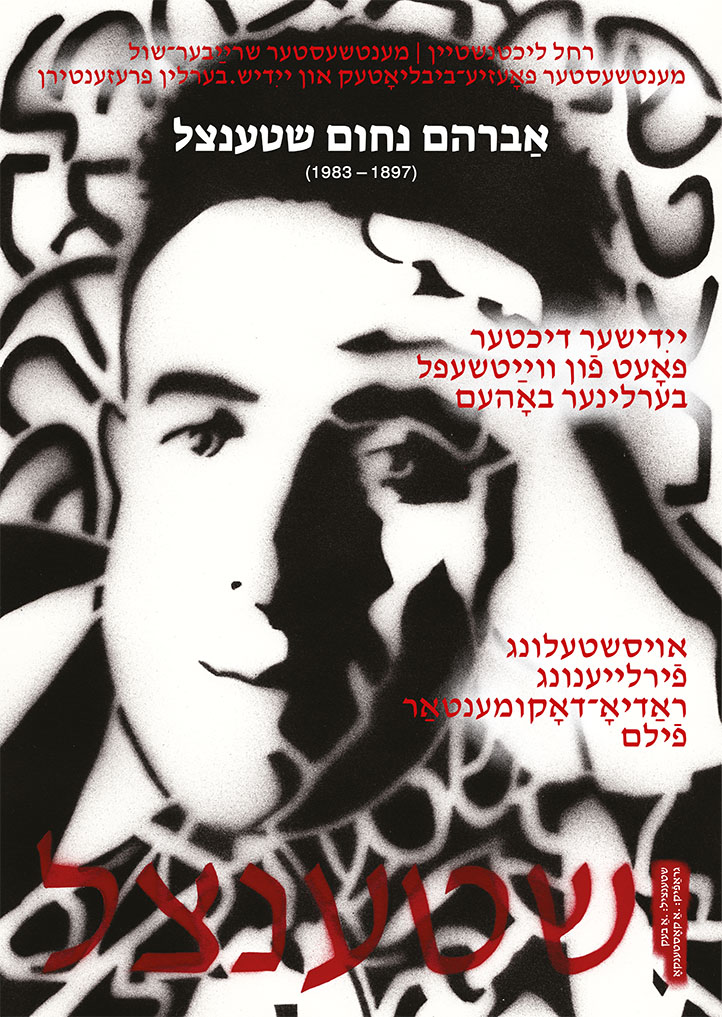
7 to 12 April 2023 | Rachel Lichtenstein | Manchester Writing School | Manchester Poetry Library and Yiddish.Berlin present:
A.N. Stencl, stencil: Arndt Beck, design: Alex Kostenko
Avrom Nokhem Stencl (1897—1983)
Yiddish Writer — Poet of Whitechapel — Berlin Bohemian
EXHIBITION | READING | RADIO DOCUMENTARY | FILM
Else Lasker-Schüler called him “Hamid,” Arnold Zweig wrote a foreword for him, and Thomas Mann praised his poetry: Avrom Nokhem Stencl, a Berliner from 1921 to 1936, was one of the most acclaimed modern Yiddish poets in Weimar-era Germany, and he laid the foundations of his multifaceted and prolific poetic work in Berlin. Together with writer and artist Rachel Lichtenstein, the Manchester Writing School, and the Manchester Poetry Library, Yiddish.Berlin is setting the stage for an almost forgotten Berliner.
The exhibition gives an introduction to Stencl’s eventful life and includes multimedia work from Rachel Lichtenstein’s research including artwork, a film and radio programme, which are available in the gallery.
It is exactly 10 years since Helmut J. Psotta died largely unnoticed. Arndt Beck remembers an idiosyncratic artist who gathered important experiences of his development in Latin America, gives insights into his own work with the estate and exemplifies some backgrounds and motifs in Psotta’s work.
The exhibition is open from 6 pm — for the last time.
Arndt Beck, works as a freelance artist mainly in photography, drawing and text. As the heir of H.J. Psotta, he represents his work as if it were his own. He has also been working intensively with Yiddish for several years and is one of the initiators of yiddish.berlin.
Thursday, 29 December 2022, 8PM during the exhibition MIR ZENEN DO! [photos] open from 6PM.
Presentation in german language.
NOVILLA Hasselwerder Str. 22 12439 Berlin-Schöneweide
Admission free — Donations welcome
With the kind support of the Partnership for Democracy Schöneweide with funds from the federal program Democracy Live!