Group photo of the Syndicalist Women´s League. Milly right in the background, with semi-covered face. Year and photographer unknown. Archive Klaus Decker.
In 1920s Berlin, Milly Witkop and Rudolf Rocker were at the center of many strands of the international and German anarcho-syndicalist movement. They were closely associated with Emma Goldman, Zenzl and Erich Mühsam. Milly was very involved in the Syndicalist Women’s League, whose inner-city Berlin group she led for a time. From 1926 onwards, she was secretary of the Berlin group of the International Workers’ Association’s relief committee for imprisoned anarchists and anarcho-syndicalists in Russia. In this lecture, we trace her commitment and let her speak for herself through her articles and appeals.
A lecture with reading by the FAU History and Future Working Group.
With this collective artistic research project initiated by Arndt Beck, YIDDISH.BERLIN is honoring an extraordinary figure: the feminist and anarchist activist Milly Witkop (1877–1955).
In the spring, Beck began tracing Milly’s footsteps in Yiddish archives and reading what they found with a small reading group. The result is a collective exhibition that investigates, honors, and makes visible Milly’s life through audio, drawings, text, mail art, collage, and more – accompanied by a series of events (see below).
Milly was born into a poor, frum family in the town of Zlatopil, in what is now Ukraine, the eldest of a tailor’s four daughters. At seventeen, she migrated on her own to London, where she soon became part of the circle around the Yiddish anarchist newspaper Arbeter Fraynd and one of the leading activists in the Jewish workers’ movement in early-twentieth-century London.
Milly lived through turbulant and combative times in England – including her own imprisonment and repeated migration. She then spent the Weimar years in Berlin, where she helped shape the Syndicalist Women’s Union (Syndikalistischer Frauenbund), and fled Germany immediately after the Reichstag fire, making her way to the United States via Switzerland. She lived outside New York for the rest of her life.
On the seventieth anniversary of her passing, we commemorate a life of political struggle for a just and humane world.
24 November – 2 December 2025, daily from 11 am
Opening: 23 November 2025, 4 pm
With an audio presentation by studio lärm and Anna Rozenfeld, a staged reading by Yossi Lampel, Guli Dolev-Hashiloni, Arndt Beck and music by Zhenja Oks.
And collective and individual artworks by Yael Merlini, Zuzanna Hertzberg, Ori Tor, among others.
I would want to write to someone A love letter, a love letter…
(Celia Dropkin)
Design: Osian Evans Sharma and Michelle Bernstein
What gives the material for love letters? Tender declarations of one’s feelings, promises to be faithful until the end of the days, and gentle words of admiration. And also: desire, sexual hunger, bittersweet longing for a beloved body – and longing in general, and pain of unanswered love, jealousy, doubts, fears, – a sometimes grief for the love that is no more, and light sorrow about the past. In one word, the whole kaleidoscope of human feelings. Yiddish poets know a lot about it.
So come to the poetry evening on February 13th to explore the nuances of love through the words of old and new Yiddish writing.
You will hear texts by: Celia Dropkin, Uriel Weinreich, Anna Margolin, as well as contemporary Yiddish poets from Berlin.
Featuring writing by:
Luise Fakler, Katerina Kuznetsova, Daria Ma, Yael Merlini, Jordan Lee Schnee, Jake Schneider – and more!
Music by Zhenja Oks
Introduction and moderation: Osian Evans Sharma and Michelle Bernstein
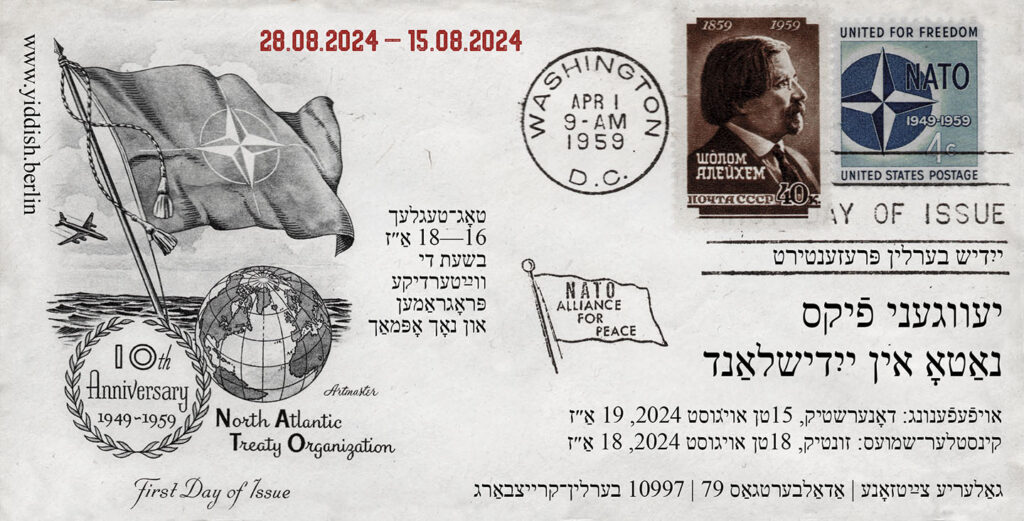
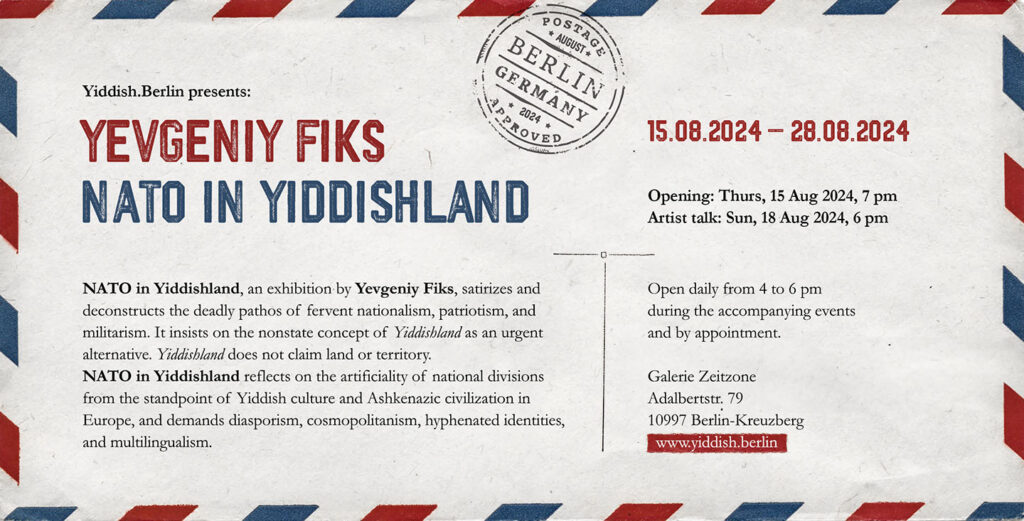
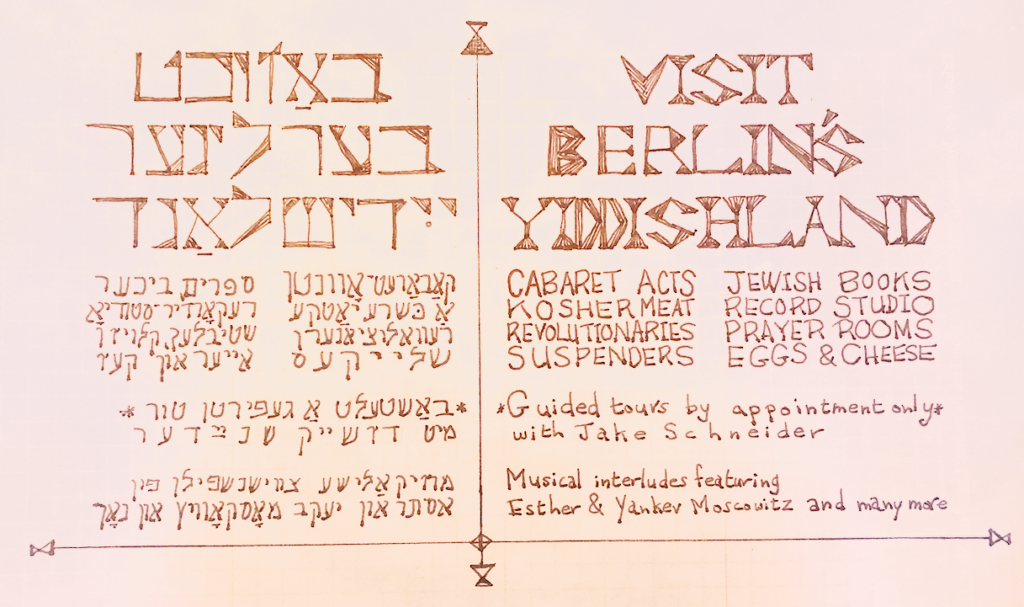
NATO in Yiddishland, an exhibition by Yevgeniy Fiks, satirizes and deconstructs the deadly pathos of fervent nationalism, patriotism, and militarism. It insists on the non-state concept of Yiddishland as an urgent alternative. Yiddishland does not claim land or territory. NATO in Yiddishland reflects on the artificiality of national divisions from the standpoint of Yiddish culture and Ashkenazic civilization in Europe, and demands diasporism, cosmopolitanism, hyphenated identities, and multilingualism.
***
This exhibition also marks Yiddish.Berlin’s 5-year anniversary. During this time, many people have invested their idealism, creativity, and priceless unpaid labor into cultivating the fertile ground on which a new Yiddish community has been growing in Berlin. Due to a last-minute loss of expected funding, we have now put forward the money for this exhibition out of pocket, which we unfortunately cannot afford ourselves. Your donation would help pay for our two weeks´ rent at the gallery, installation costs, live performances and presentations at the events, and making sure that there is someone in the gallery every day who can explain the concept of “Yiddishland” to anyone who walks in off the street. A sheynem dank!
Although Yiddish.Berlin has been less active lately as an official (or rather, very unofficial) group, Berlin’s decentralized, DIY Yiddish community is livelier than ever.
There is a whole series of major Yiddish-related events coming up in the city:
13 April – PARATAXE Symposium XIV: Hebrew? Yiddish? Berlin?This symposium at the Kulturbrauerei will be devoted to literature written here in Berlin in Yiddish and Hebrew, past and present. The Yiddish scene is the focus of the 4pm panel and will also be represented with original poetry and music in the evening reading at 8pm.
14 April – Haus für Poesie: For you, whoever you are: Yiddish poetry. This reading, curated by Jordan Schnee, brings together the contemporary Yiddish poets David Omar Cohen (Amsterdam) and Beruriah Wiegand (London/Oxford) with music by Daniel Kahn (Hamburg) and text-based visual art by Ella Ponizovsky Bergelson (Berlin).
24-28 April – The 2024 Shtetl Berlin festival! Save the dates. More information on this annual whirlwind of Yiddish music and culture will be available soon on their website. Meanwhile, their next klezmer jam sessions at Oblomov will be happening on 13 March and 11 April, plus a Yiddish singalong on 27 March.
Apart from that, here are some updates on ongoing developments in the local Yiddish community:
A new Yiddish poetry writing group, coordinated by Katerina Kuznetsova, is now meeting every two weeks to discuss its members’ original Yiddish poems, which they have recently performed at the London-based Yiddish Open Mic Cafe, a reading organized by Leivik House in memory of Moyshe Dovid Guiser, and probably more.
The longstanding weekly reading group, coordinated by Arndt Beck, remains devoted to our Berliner zeyde Avrom Nokhem Stencl. Besides reading his poems every Sunday, participants have also been translating Stencl’s poetry and prose into four languages.
A new initiative is underway to create a mini-library of books in and about Yiddish called the Berliner Tshemodan-Bibliotekl (the Little Berlin Suitcase Library). After a spontaneous fundraising drive (you can still donate here), three of us traveled to Hamburg for a Yiddish book sale by the Salomo-Birnbaum-Gesellschaft. We did indeed return home with a suitcase full of Yiddish books. More information about the library soon.
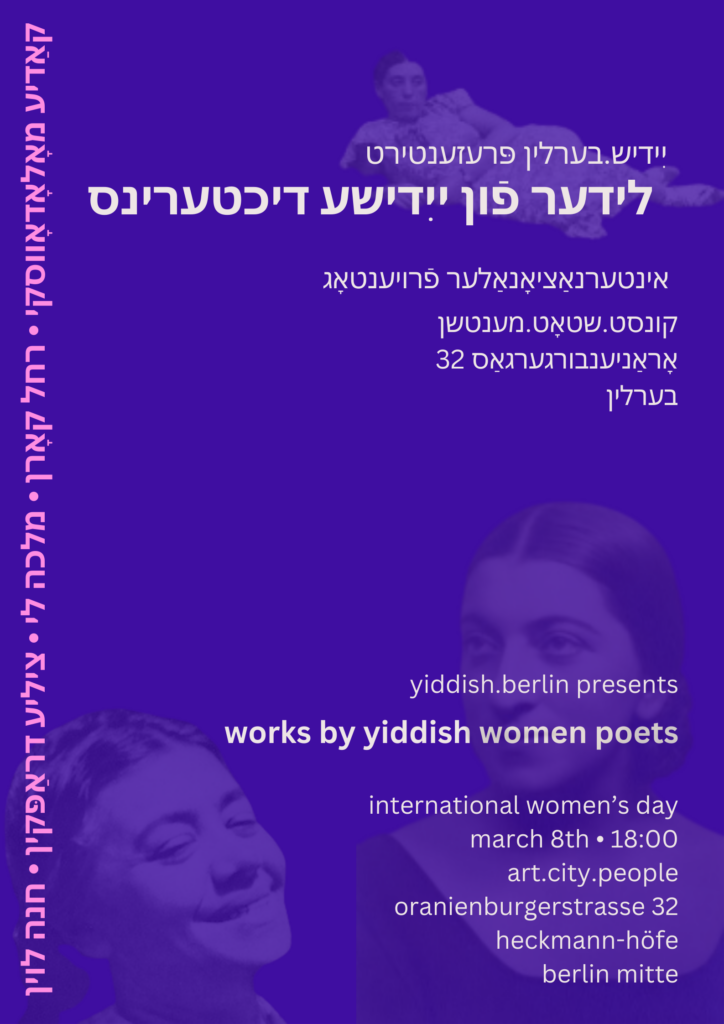
The International Women’s Day is an important holiday for us. This year we want to honour the works of women who have been creating Yiddish literature since the Middle Ages. We will recite works of famous Yiddish women poets, such as Kadya Molodowsky, Celia Dropkin, and Rokhl Korn, as well as less-known authors.
However, we don’t concentrate only on the past! That’s why in the second part you will hear contemporary works of Berlin Yiddishistkes: poetry, music, and translations.
Featuring:
Luise Fakler | Sandra Israel-Niang | Katerina Kuznetsova | Sasha Lurje | Yael Merlini | Rose Mintzer-Sweeney | Maria Stazherova | Ro van Wingerden | Iryna Zrobok
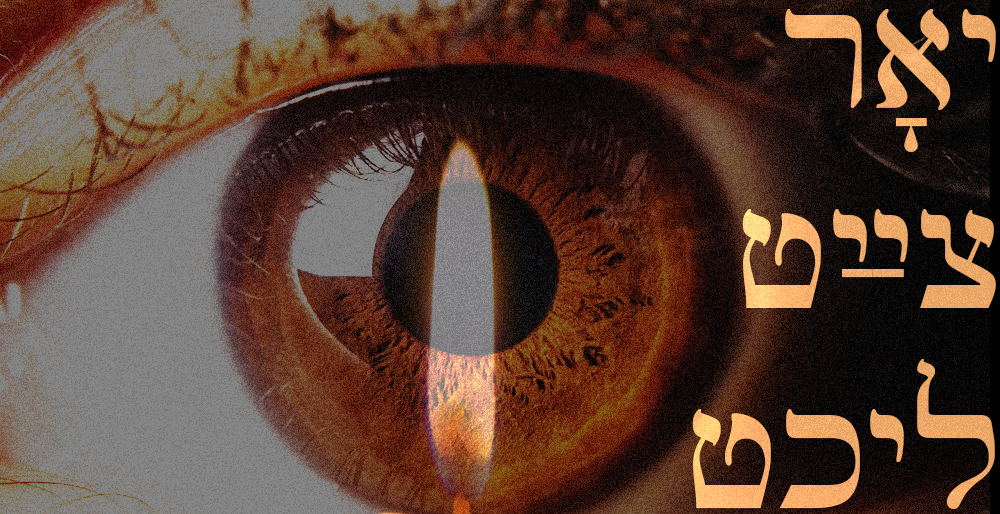
“From you, the killers have taken away what to see with, and from me, they have taken away what to see.”
A hospital in the Soviet Union, 1946. Tropimov can’t sleep. In the morning, when the bandages are finally removed, he will find out whether he can see. Meanwhile Dr. Soyfer, who operated on him, is dreaming of the mother he will never see again.
A dramatization of a story written immediately after the war by one of Berlin’s greatest Yiddish authors, Dovid Bergelson (1884–1952).
Original story by Dovid Bergelson, dramatized by Dovid Likht
Initiated and directed by Daniel Galay, chairman of the Leyvik House in Tel Aviv
The reading will be in Yiddish with no translation.
Featuring Daniel Galay as Yerofey Simyonovitish Tropimov, Jake Schneider as Dr. Soyfer, Anna Rozenfeld as Krankenshvester, and Osian Evans Sharma as the narrator.
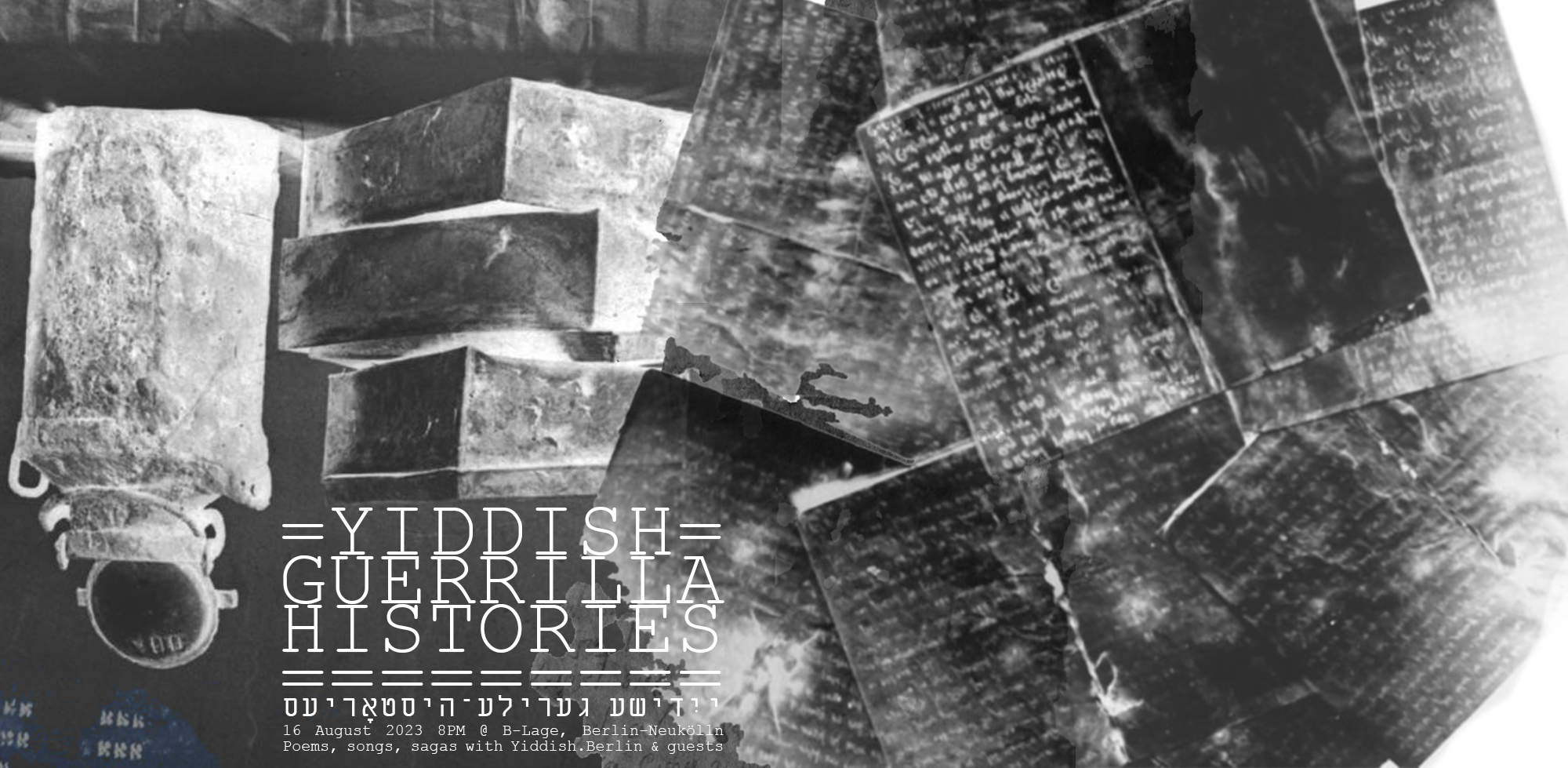
History is written by the powerful. But what happens when the powerless insist on preserving and interpreting their own experiences: sharing them in secret gatherings, publishing them in underground newspapers, and burying the archives in milk cans for survivors to read? What does it mean to write collective and creative chronicles in a language with no army or navy? What makes our stories into histories?
Yiddish Guerrilla Histories will dig up and translate a few of these defiant acts of memory from 1914 to 2023, including poems, songs, and sagas, and share them with a trustworthy audience.
Reading and presentation in English and (translated) Yiddish
—
With special guests Sarah Silberstein Swartz and Zohar Weiman-Kelman, as well as Berlin’s own Guli Dolev-Hashiloni, Katerina Kuznetsova, Michaela Kobsa-Mark, Jake Schneider, Ro van Wingerden, and Janina Wurbs
Featuring the Yiddish writings of Rokhl Oyerbakh, Anna Margolin, Malka Lee, Leyb Kvitko, and Irena Klepfisz, Yente Mash, and Chava Rosenfarb, plus some music
A project of Yiddish.Berlin, curated by Jake Schneider
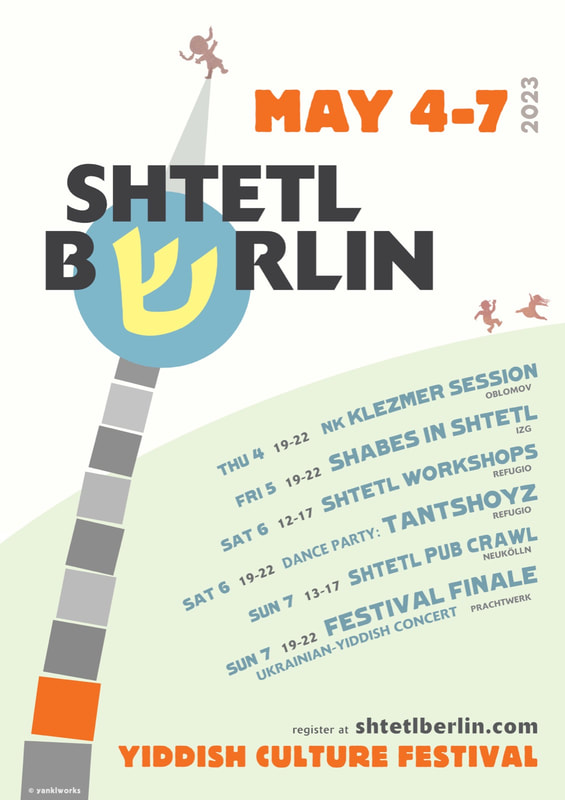
Is it Hanukkah already? No, this year our friends’ legendary SHTETL BERLIN festival is happening in the spring. Don’t miss the opening 95th Neukölln Klezmer session on Thursday. Make sure to catch Shabes in Shtetl Friday night (including some poems from Yiddish.Berlin). Dive into the workshops, dance at Tantshoyzbiz in vaysn tog arayn, then roll out of bed for the very first Shtetl Pub Crawl (where some of us will be speaking Yiddish). Which is only a warm-up for the grand Festival Finale. See you there!